

Objective of the game
The official rules of chess are established by the International Chess Federation.
There are many variants of the game of chess, in which the rules may differ to varying degrees. Official competitions follow the standard rules of chess.
Under the official rules, the objective of the game is to deliver checkmate, which ends the game. However, most games end with one player resigning before checkmate is actually delivered (another term for checkmate is “mate”).
General concepts
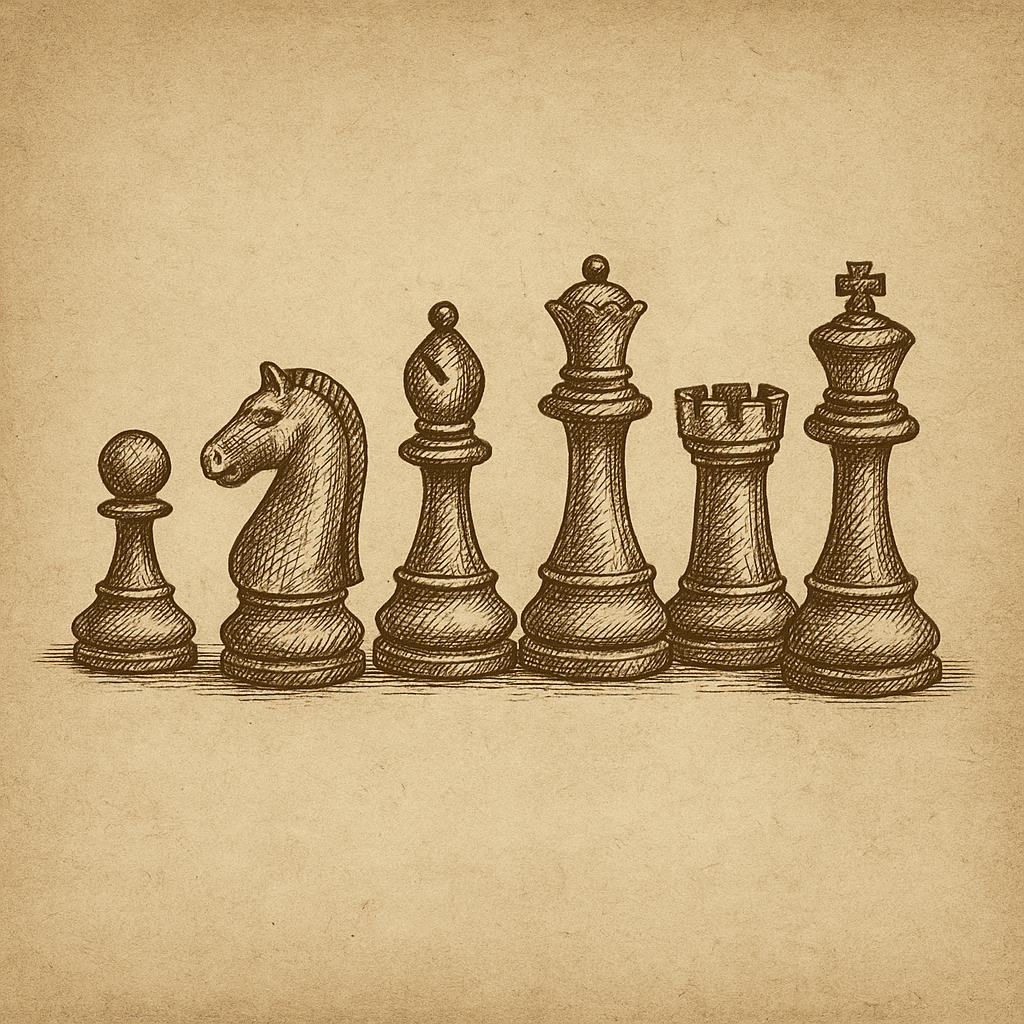
The pieces
There are 6 types of pieces, whose movements and influence will be detailed in the next section (Movement).
In the illustration below, from left to right, you will find:
The Pawn
The Knight
The Bishop
The Queen
The Rook
The King
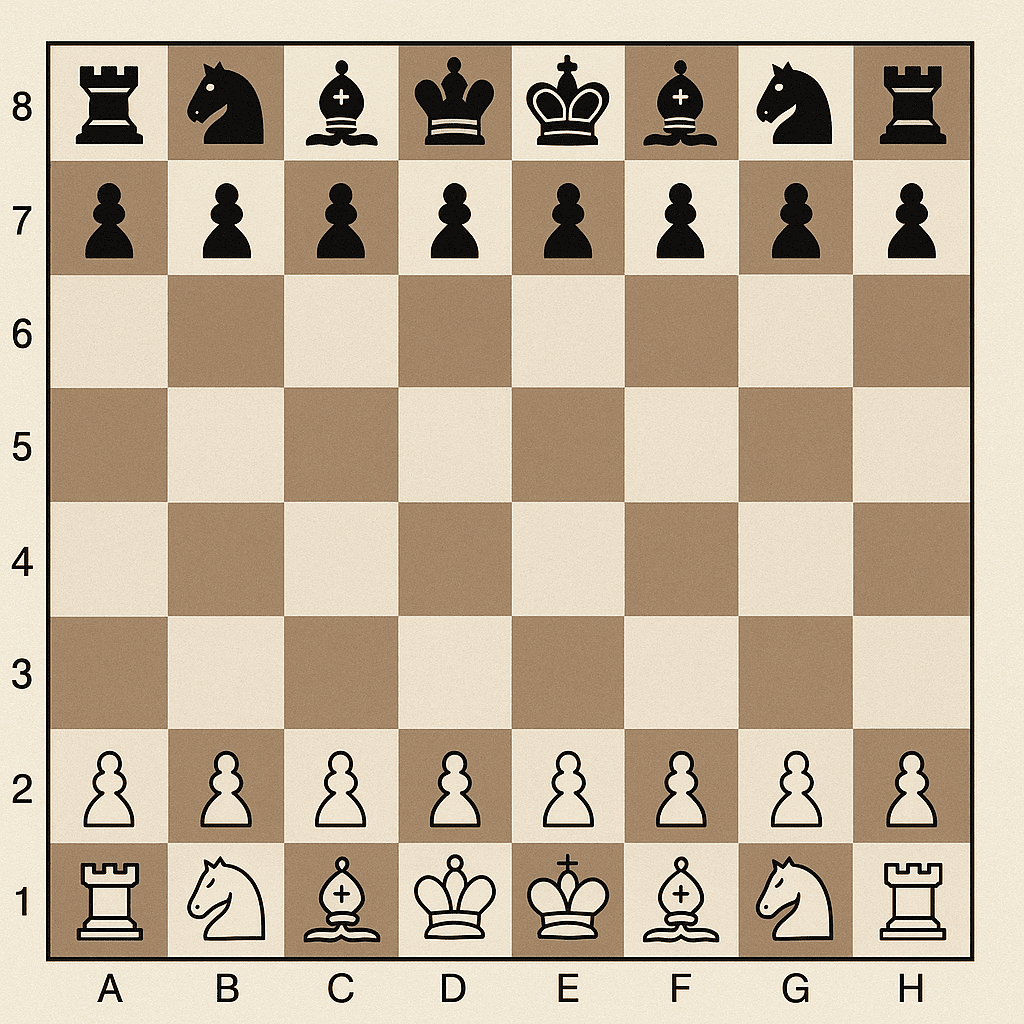
The starting position
The eight vertical lines of squares are called files (i.e., all squares sharing the same letter).
The eight horizontal lines of squares are called ranks (or more rarely, rows) (i.e., all squares sharing the same number).
The 45° slanted lines are called diagonals.
At the start, White is always placed on ranks “1” and “2,” and Black on ranks “8” and “7.” By convention, each player must have a light square on their right (h1 for White and a8 for Black).
Each player initially has one king, one queen, two bishops, two knights, two rooks, and eight pawns.
The queens face each other on the “d” file. A simple mnemonic for beginners is to place the queens on the central square of their color: the white queen on a light square and the black queen on a dark square.
At the beginning of the game, half of the squares are occupied by pieces, leaving a free playing space of four ranks in the center of the board.
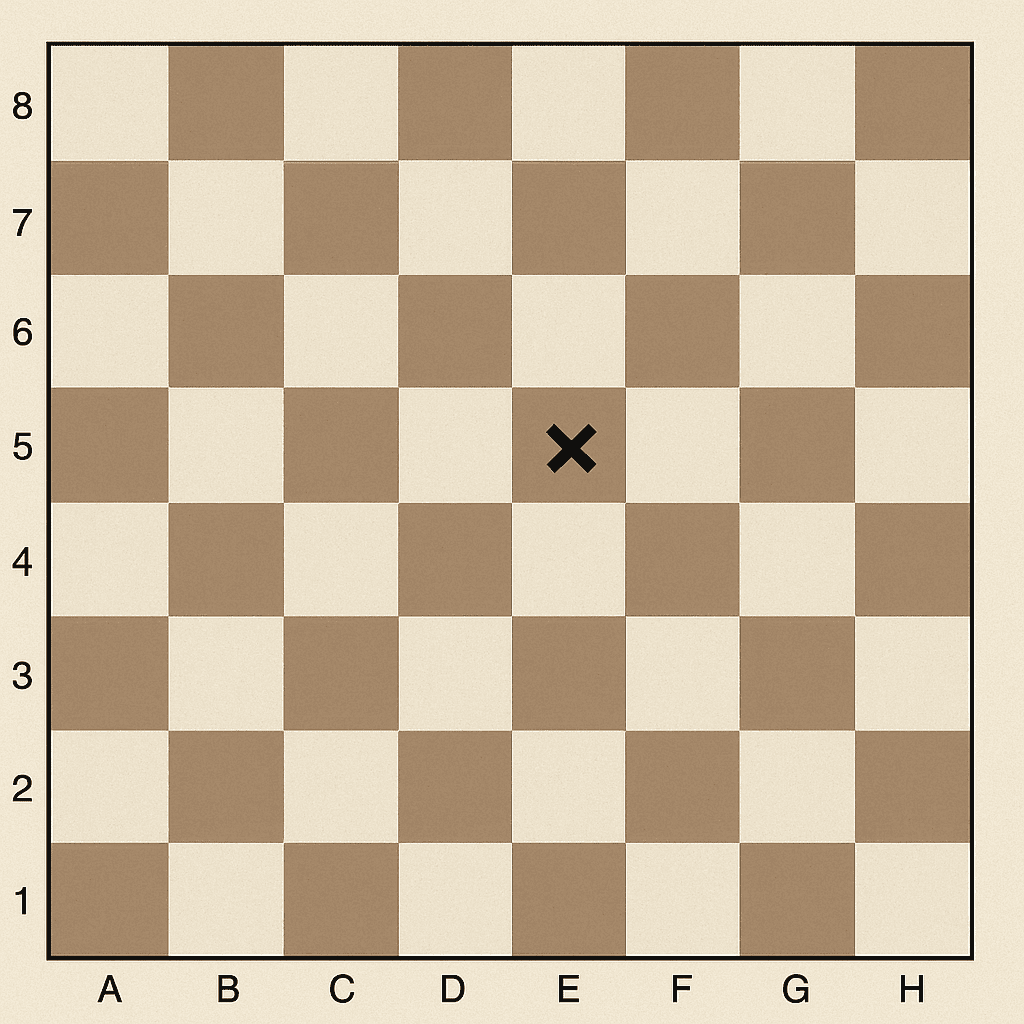
The chessboard
To allow moves to be recorded, the files are designated by lowercase letters from “a” to “h” (the “a” file being the leftmost for White), and the ranks by numbers from 1 to 8 (rank “1” being the one with the white pieces).
Each square is represented by a file–rank combination, for example “e5.”
File and rank indicators are sometimes omitted on the board or in diagrams, as only beginners really need them.
Each piece occupies a single square, and each square can hold only one piece.
Playing a move consists of moving one of your pieces, possibly accompanied by the capture of an opponent’s piece located on the destination square (except in the case of en passant captures). With the exception of castling, a move cannot involve moving two pieces of the same side at once.
If you decide to move your piece onto a square occupied by an opponent’s piece, that piece is removed from the board: it has been captured. Unlike in checkers, captures are not mandatory in chess (except in situations where the only legal way to escape check is to capture the attacking piece).
White and Black play alternately. White makes the first move of the game. Colors may be assigned by agreement between the players or by chance.
The player whose turn it is to move is said to have the move, and playing is mandatory (you cannot “pass” your turn). Being forced to move can sometimes be a disadvantage when all available moves worsen the position—this is known as zugzwang. If the player to move is unable to make any legal move, the game ends (either in stalemate or checkmate).