The basic principles of the Scandinavian Defense are :
Black challenges the center immediately, from the very first move.
After 2.exd5 Qxd5 3.Nc3, the black queen is chased and must retreat.
It is a simple opening to understand, but it often gives White a small development advantage.
It allows beginners to get out of the opening phase without major weaknesses and without needing to learn heavy theory.
Strengths
A direct and straightforward opening → easy to learn, even for amateur players.
Allows Black to avoid the heavy theory of the Sicilian or the French Defense.
Often leads to open and dynamic positions.
Black’s structure is solid as long as White does not exploit their development advantage.
Weaknesses
The early development of the black queen (2…Qxd5) exposes it to attacks.
White often gains a tempo in development by chasing the queen.
Black can end up somewhat passive if their development is slow.
Some experienced players know aggressive lines designed to punish the Scandinavian.
The Main Line
Basic position
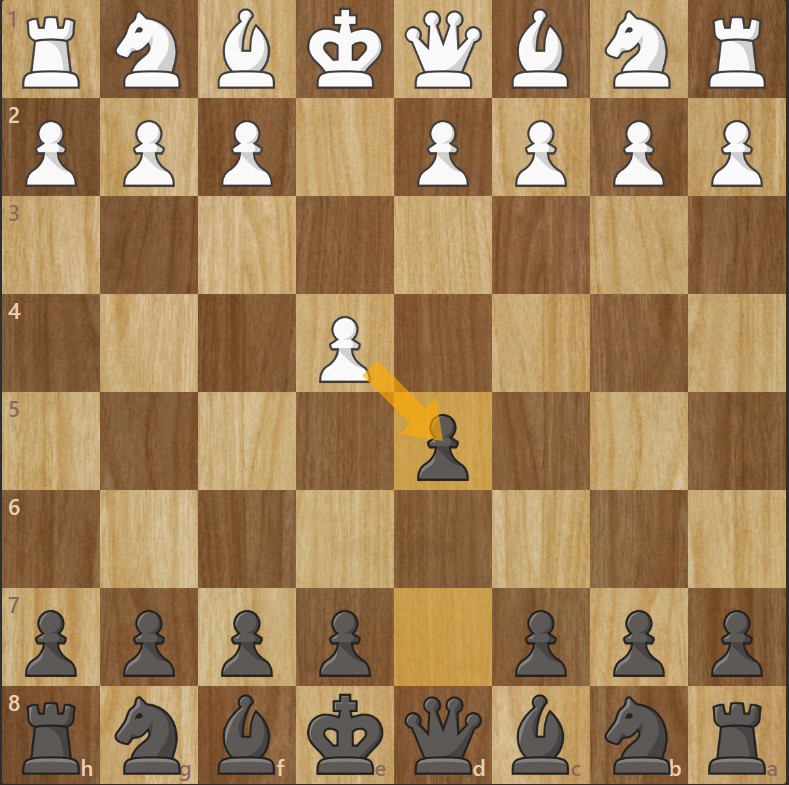
1. e4 d5
This is the starting position of the Scandinavian Defense. Black chooses to challenge the center with their d-pawn.
The main line we will explore here also happens to be the strongest and most principled move for White:
2. exd5
Battle for the center
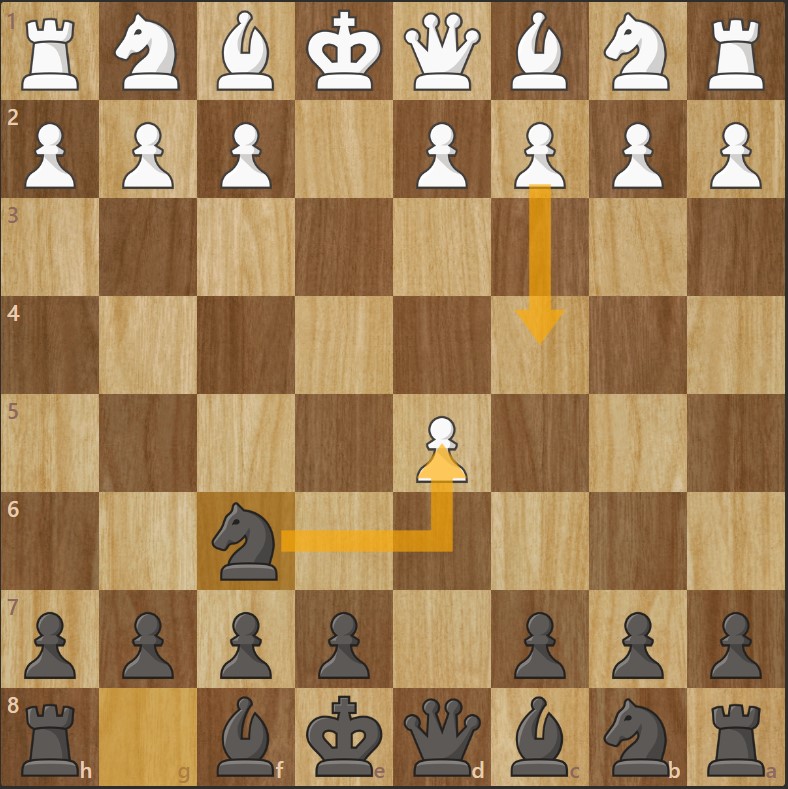
2. exd5 Nf6
White captures the d-pawn and occupies the center.
Black avoids exposing their queen too early and develops a piece instead.
WARNING: It is a mistake for White to try to hold on to this pawn at all costs — especially with the move
3. c4
Black would gain a positional advantage early in the game.
White falling behind
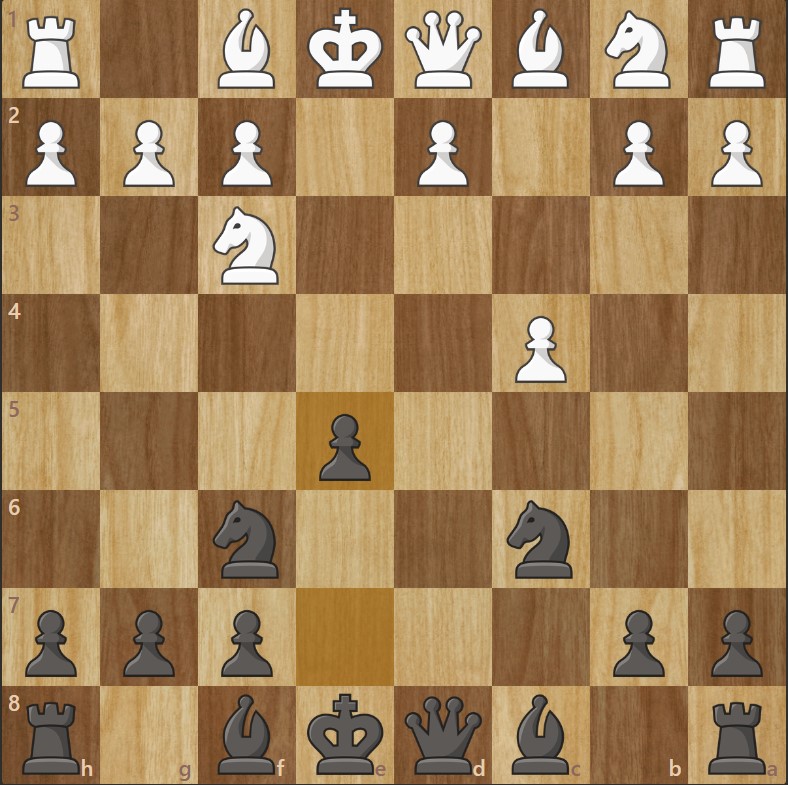
This is why White should not try to protect the d5 pawn. After :
c4 c6
dxc6 Nc6
Nf3 e5
We can see that Black controls the center and has an extra developed piece.
Protecting with Nc3
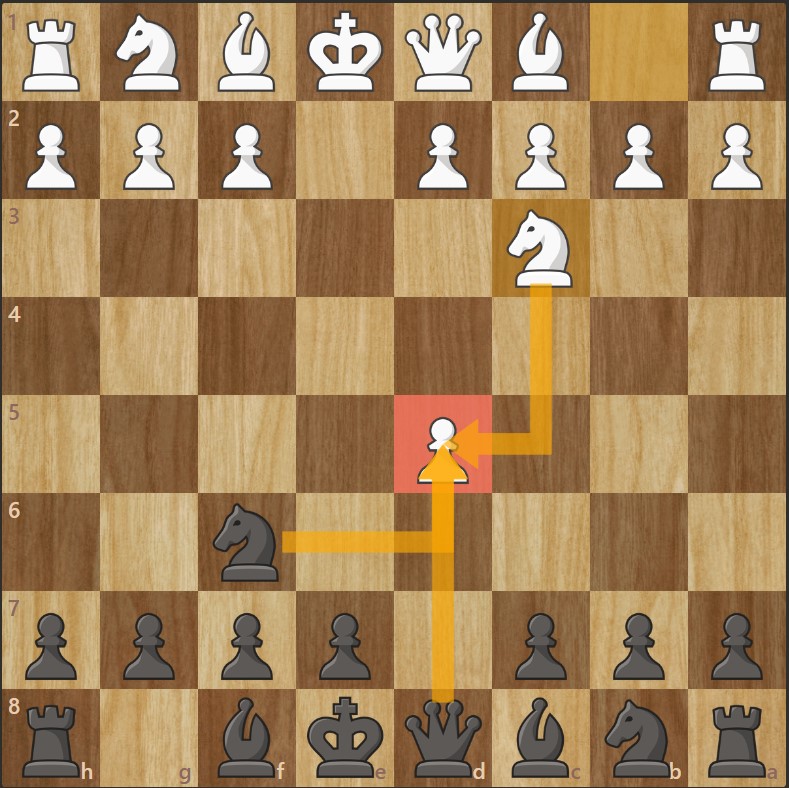
3. Nc3
If White tries to protect the pawn by developing the knight to c3, Black can now exchange pieces on d5.
The fact that the black queen ends up in the center after this exchange is less problematic than before. Indeed, White no longer has the knight that could have chased the queen and gained a tempo.
Possible continuation
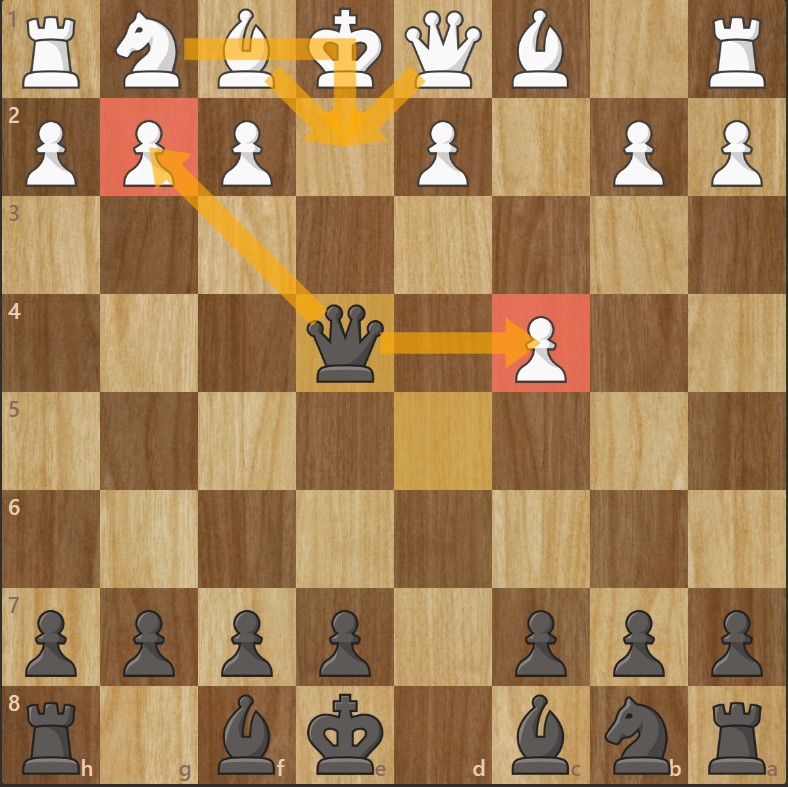
After the exchanges, if White chooses to chase the queen by pushing the c4 pawn…
5… Qe4+
Black threatens both the g2 and c4 pawns if White blocks the check with the bishop or the knight.
6. Qe2
White parries the check with the queen (the only viable move).
7. Qxe2 Nxe2
After the queen exchange, the endgame is pleasant for Black to play. (+0.89)
Without chasing the black queen
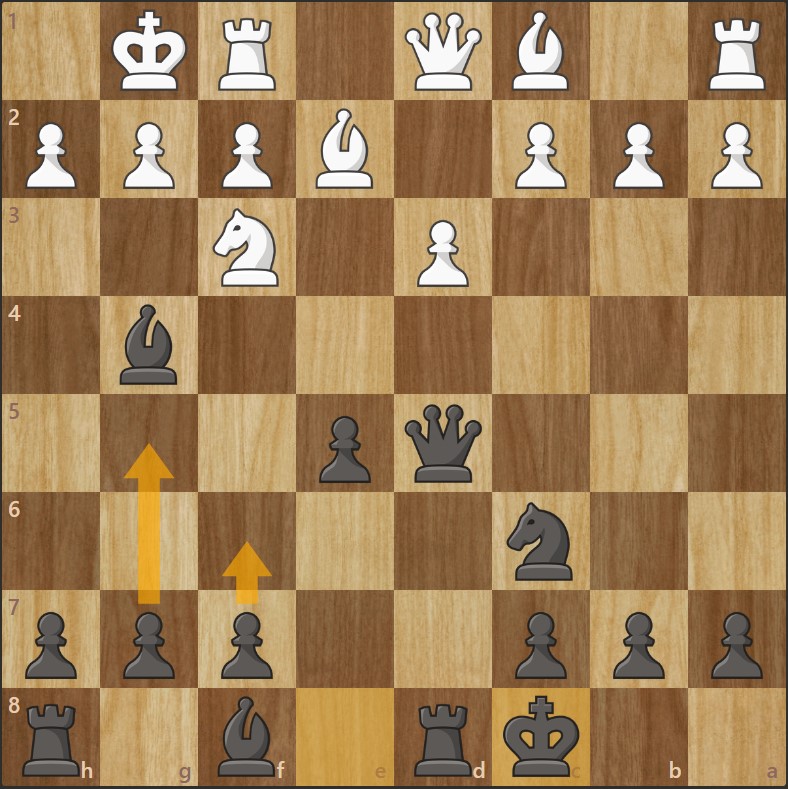
Here is what the position may look like after about ten moves. White is far better off developing their pieces than trying to chase the black queen.
This often leads to opposite-side castling, where Black will look to launch an attack as shown in the diagram above.
A good response for White
3. Nf3 Nxd5
White develops.
Black recovers their pawn deficit.
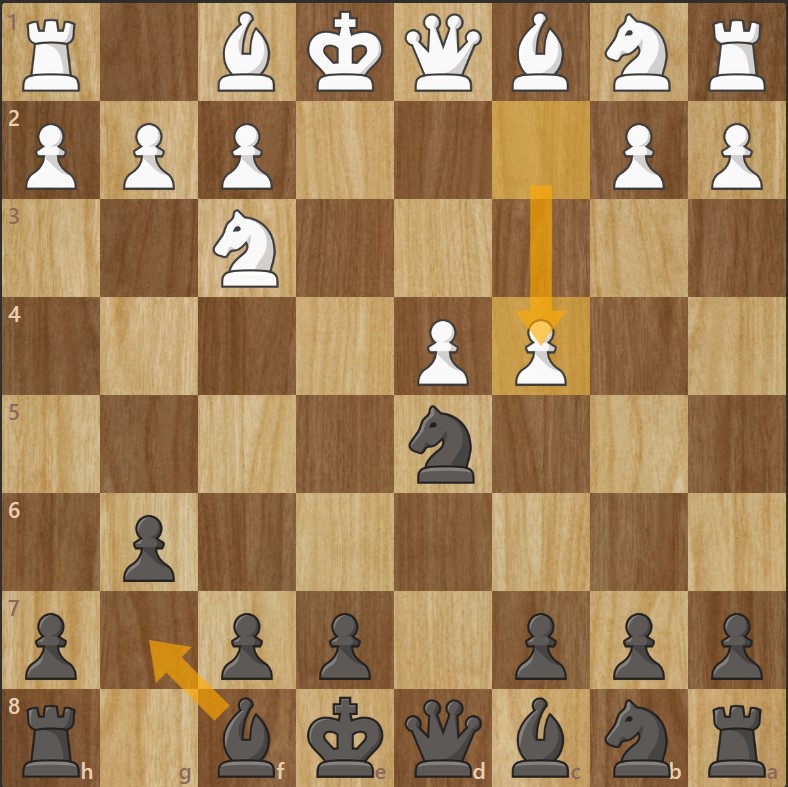
4. d4 g6
White claims more central space.
Black prepares to fianchetto their bishop.
5. c4
White puts pressure on the center and gains a tempo by attacking the knight.
At this moment, the evaluation is +0.92 for White.
Pressure on d4
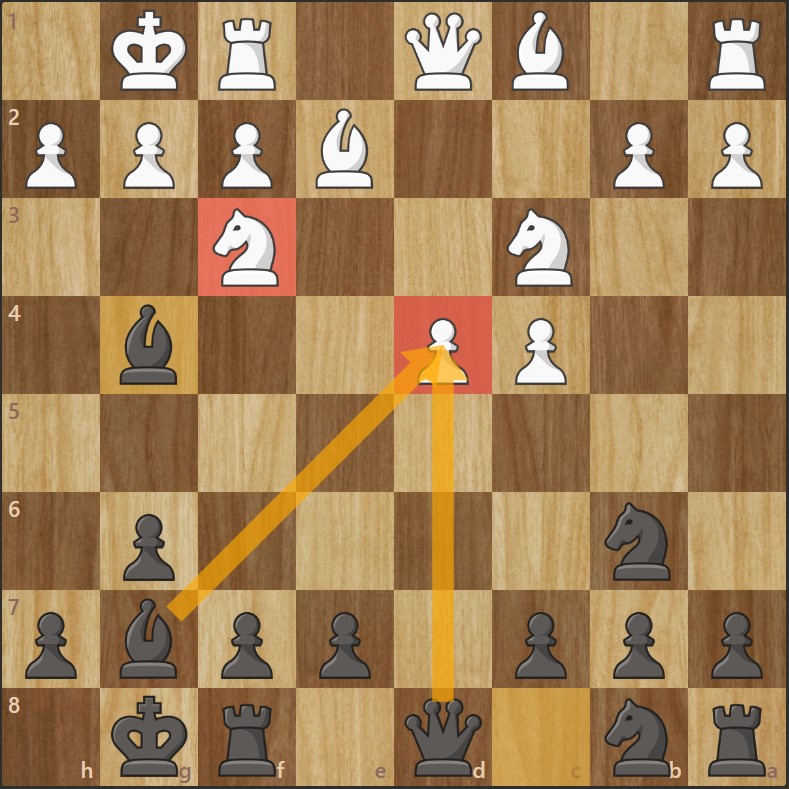
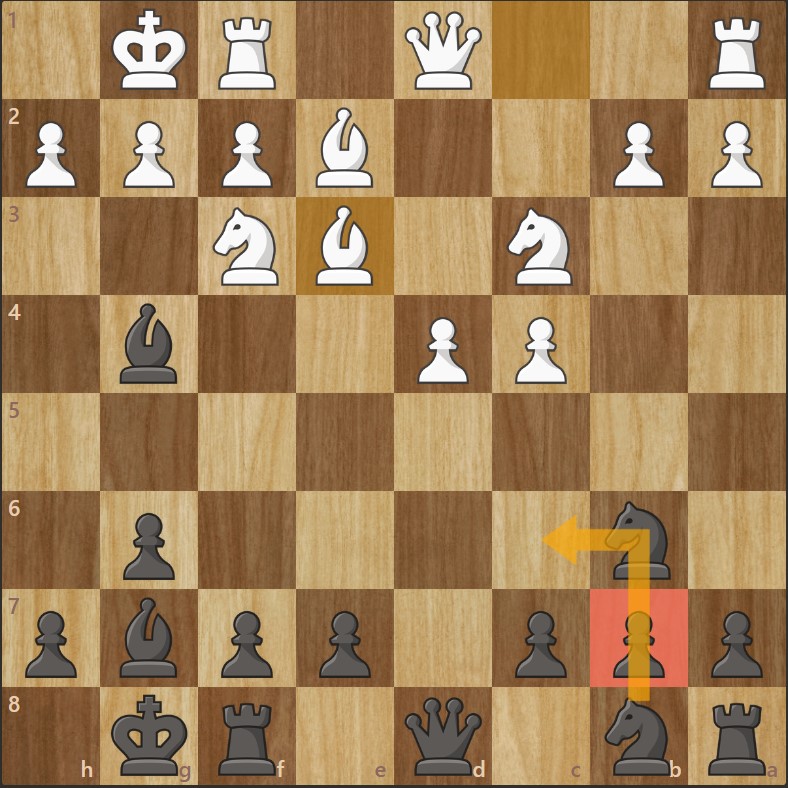
Black’s idea is to put pressure on the center and take advantage of their open queen file.
After a few standard development moves, the d4 pawn can be recovered by Black.
First, by capturing the knight on f3, removing one of the two defenders of d4.
Second, White would be forced to recapture on f3 with their bishop from e2 (otherwise their castling structure would be ruined), which means they would also give up protection of the c4 pawn.
Equal position
9. Be3
White adds another defender to d4 and develops a bishop.
9… Nc6
Black must prioritize this move to prevent White from targeting the vulnerable g7 pawn.
If Black does not play precisely in this order and tries to win the d4 pawn too quickly, they expose themselves to a fast and dangerous counterattack !
If White does not capture…
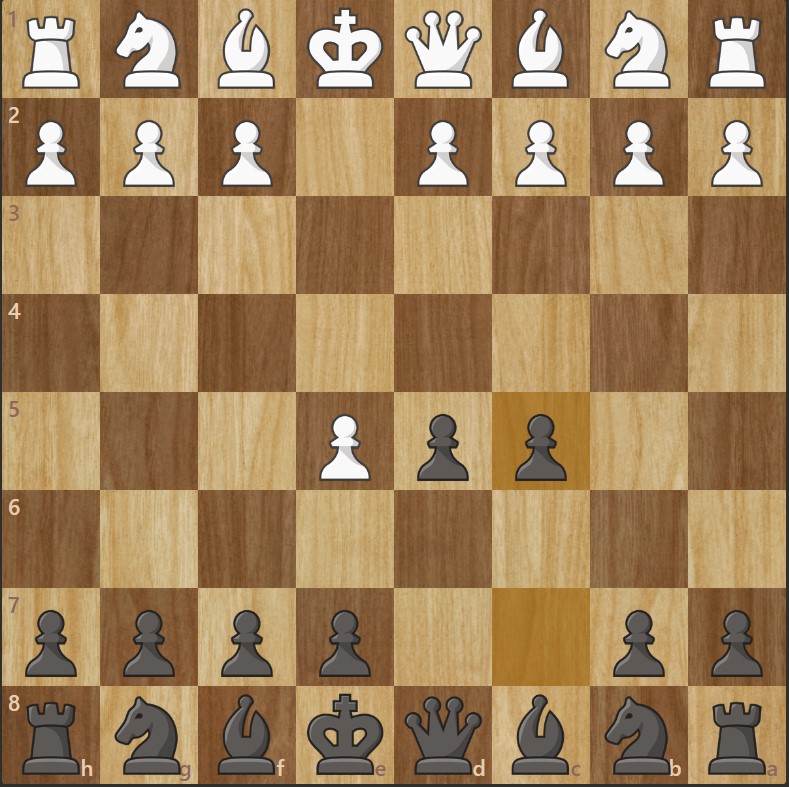
The White push
In this case, instead of capturing the d5 pawn, White chooses to continue taking space.
2…c5
Black must keep pressure on the center and prevent White from defending the e5 pawn with d4.
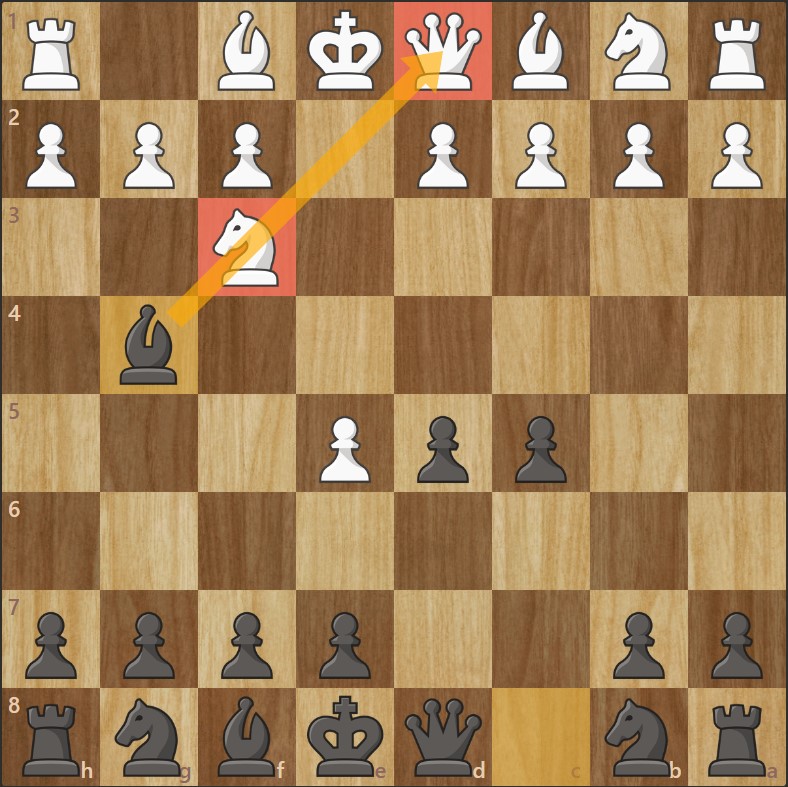
The pin
3. Nf3 Bg4
White develops the knight and adds support to the e5 pawn.
Black immediately pins this knight, which will often be captured later.
The idea is to reduce White’s central strength and, if possible, saddle them with doubled pawns on the f-file.
Fight for the center
4. c3 Nc6
White aims to maintain a strong pawn chain in the center capable of defending e5.
Black develops the knight to c6, increasing pressure on d4.
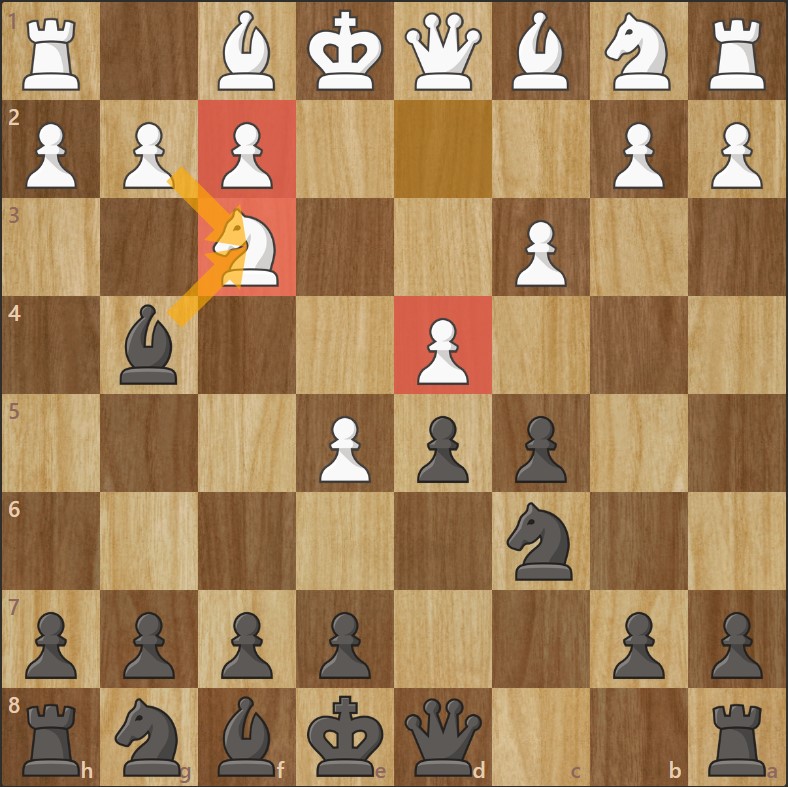
5. d4 Bxf3
White advances in the center.
Black captures the knight on f3.
White is then forced to recapture with the f-pawn, stacking pawns on the f-file, because recapturing with the queen would abandon the defense of d4.
In summary, the Scandinavian Defense is :
1. Easy to learn :
The resulting structures are often similar.
There are only a few key ideas to remember.
2. Playable without knowing complicated variations up to ~1400 Elo :
A very suitable opening for beginners when playing Black.
WARNING: Beyond a certain level, you will need to know more advanced lines, or switch to openings with richer theory.
3. Perfect for focusing on other areas of the game :