

Sicilian defense
- Black does not respond symmetrically to 1.e4; instead of …e5, they play …c5.
- Objective: control the d4 square and create a structural imbalance.
This often leads to asymmetrical positions:
-
White seeks the initiative on the kingside,
-
Black counterattacks on the queenside.
The Sicilian Defense is one of the most heavily documented openings in chess theory.
What follows is a brief overview, adapted for beginner/intermediate players (<1700 Elo).
At the bottom of the page, you will find the variation that best matches your player profile.
Strengths
A fighting opening: no symmetrical play, and Black’s winning chances increase.
Leads to dynamic positions with active counterplay.
A preferred defense of many World Champions (Fischer, Kasparov, Carlsen).
Very flexible: depending on the chosen variation, Black can play solidly (…e6, …d6) or extremely sharp (…d5, …g6, …a6).
Weaknesses
White often obtains a space advantage and an initiative that is easier to play.
Many variations are highly theoretical: good preparation is required to avoid getting swept off the board quickly.
If Black fails to find counterplay, they risk getting suffocated in a passive position.
Some lines (such as the Grand Prix Attack or the English Attack) give White extremely dangerous direct attacks on the kingside.
Open Sicilian
Starting position
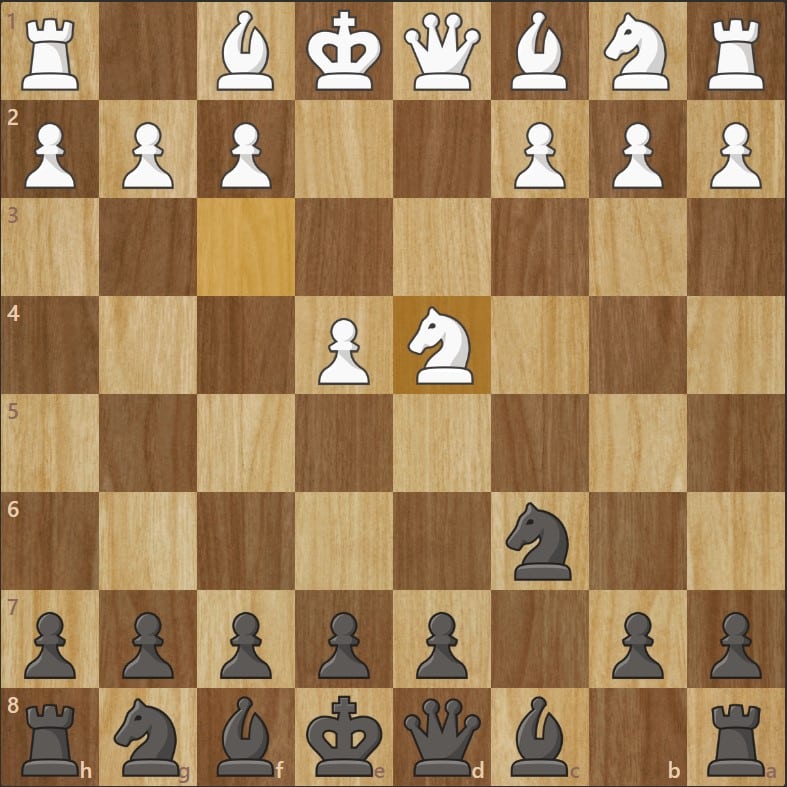
1. e4 c5
- White takes the center with e4.
- Black replies with …c5, indirectly controlling d4 and creating asymmetrical play.
2. Nf3 Nc6
- White’s knight attacks e5 and prepares d4.
- Black’s knight defends e5 and targets d4.
3. d4 cxd4
- White opens the center immediately.
- Black captures on d4.
4. Nxd4
- White’s knight recaptures and occupies an active central square.
White’s strength: spatial advantage.
Black’s strength: potential central pawn majority.
At this stage, Black has several major options that define the main branches of the Sicilian:
4… Nf6 (attacking the e4 pawn) → Classical and Sveshnikov Variations.
4… e6 → Taimanov or Scheveningen.
4… g6 → the very sharp Dragon Variation.
4… d6 → Najdorf (after …a6) or Classical lines.
Najdorf Sicilian
4… Nf6
- Controls the e4 and d5 squares.
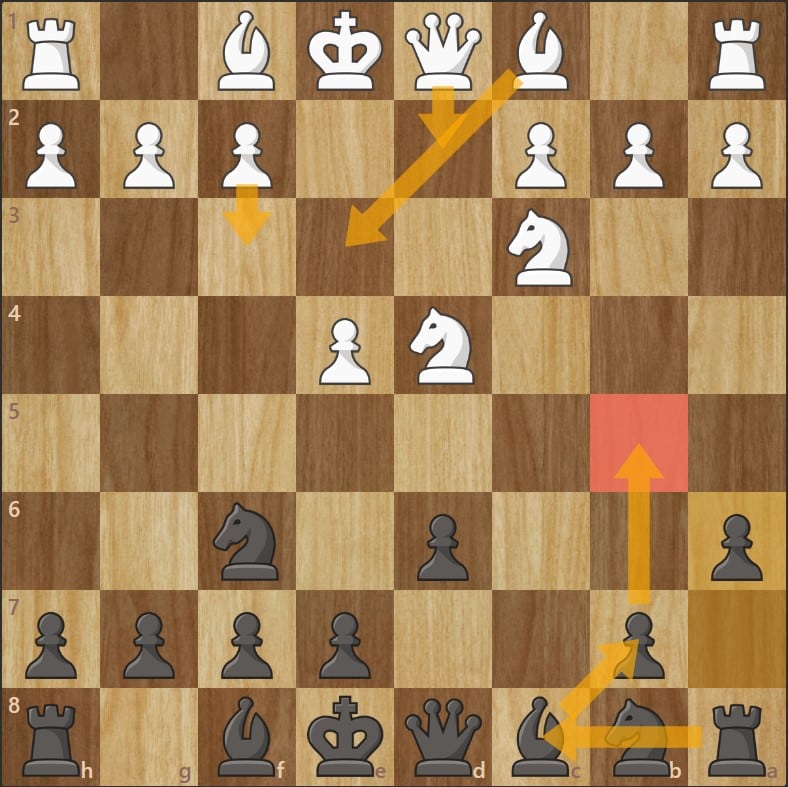
5. Nc3 a6
- White develops a second knight toward the center.
The move …a6 prevents a knight or bishop from coming to b5.
It prepares …e5 or …b5, depending on the circumstances.
This is probably the most deeply studied variation of the entire Sicilian, played by Fischer, Kasparov, and Carlsen. We won’t cover all of its subtleties here !
Black’s plan :
Queenside expansion: …b5, …Bb7, …Rc8, rapid pressure on the c-file.
…e5 to chase the knight from d4 and control the center.
…g6 and …Bg7 (Najdorf–Dragon hybrid setup).
White’s plan :
English Attack: Be3, f3, Qd2, O-O-O, then g4–g5 → massive kingside attack.
6. Bg5 (the most critical line) → direct pressure on Nf6 and the d5 square.
6. Be2 or 6. Bc4 for a more positional development.
Scheveningen Structure
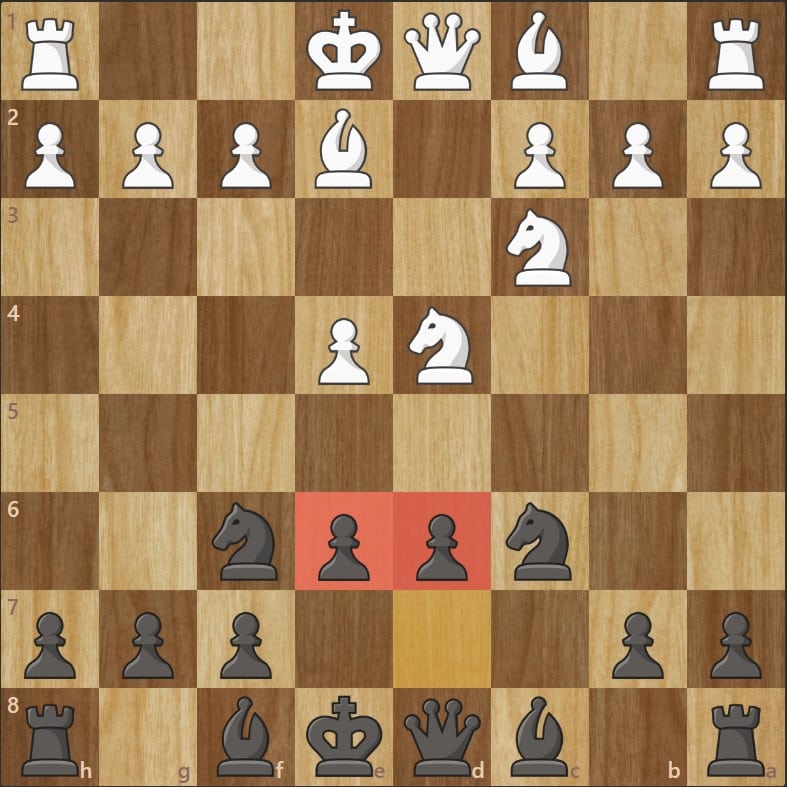
5… e6
- Black reinforces their center and prepares …d6.
A flexible structure—solid yet dynamic.
6. Be2 d6
- White develops quietly and prepares to castle.
- Black adopts the typical e6 + d6 pawn structure, the core of the Scheveningen.
Themes of the Scheveningen :
The balance revolves around:
White aiming to attack on the kingside (f4–f5, g4–g5),
Black seeking counterplay on the queenside (…b5–b4, …a5).
This opening is highly strategic, but also rich in tactics once both sides start pushing pawns.
White on the kingside
7. O-O Be7
- White castles quickly, securing the king.
- Black develops calmly and prepares to castle.
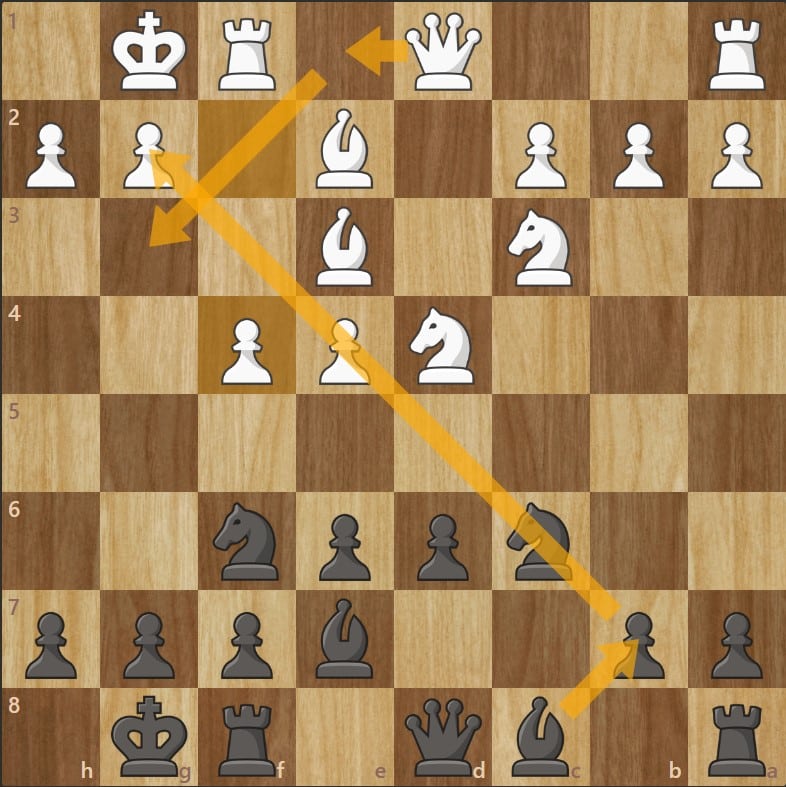
8. Be3 O-O
- White places their bishop on the key diagonal (a7–g1), supporting a future f4–f5 push.
- Black castles in turn, equalizing king safety.
9. f4
This begins White’s typical aggressive plan: a kingside pawn storm (f4–f5, sometimes g4–g5).
White prepares a future Bf3 + Qf3 + Qg3, aiming at h7.
This is the classic structure of the English Attack.
Svechnikov structure
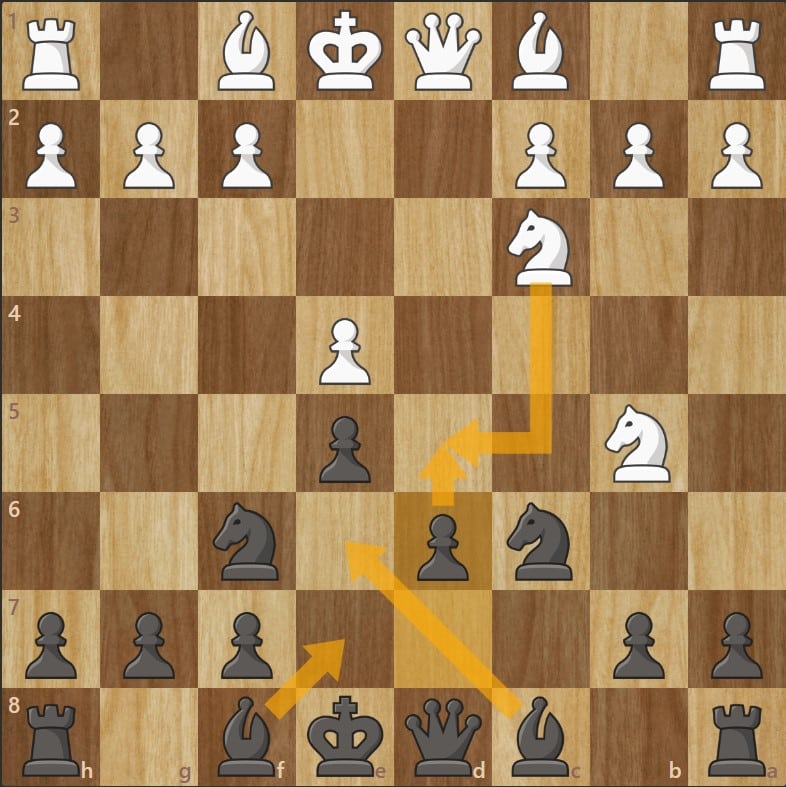
5… e5
- Black immediately attacks the knight on d4.
Objective: obtain active play by chasing the knight and occupying the center.
6. Ndb5 d6
- The knight retreats to b5, putting pressure on d6 and controlling the c7 square.
- Black supports the e5 pawn and consolidates their center.
We are officially in the Sveshnikov.
White’s main idea will be to place a knight on d5, creating a powerful outpost and restricting Black’s position as much as possible.
Black has slightly more space compared to the …e6 setups. Their main challenge will be to prepare the …d5 pawn break, the key equalizing move in the Sveshnikov.
Dragon structure
4. Nxd4 g6
- Black chooses to fianchetto their kingside bishop.
Objective: powerful control of the long h8–a1 diagonal.
This is the Dragon Defense.
5. Nc3 Bg7
- White’s knight supports the center (e4, d5).
- Black’s bishop settles on the diagonal, becoming the key piece of the Dragon.
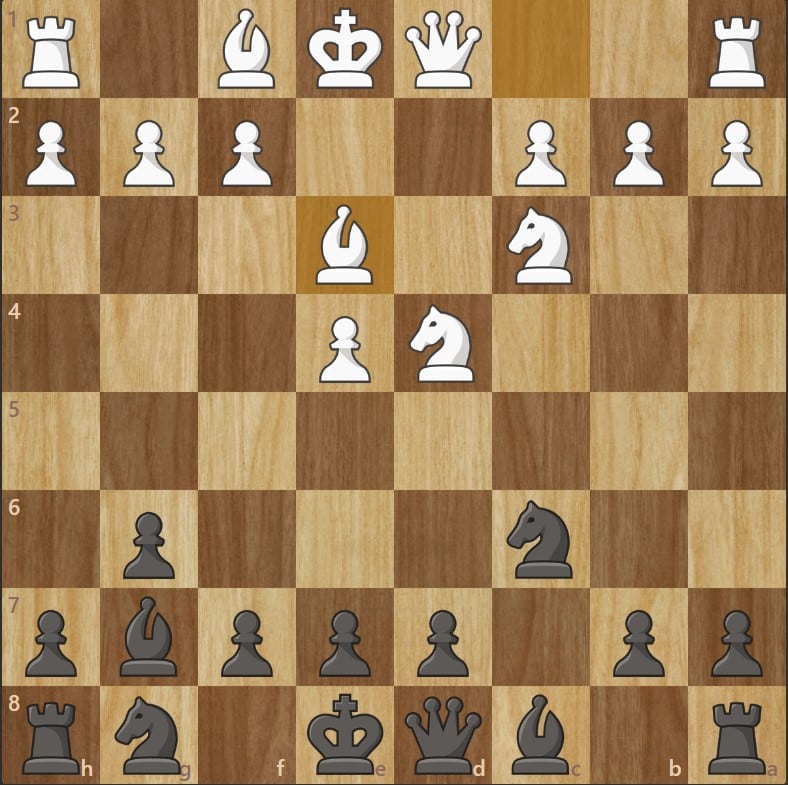
6. Be3
- White develops calmly, but this move almost always signals the Yugoslav Attack, the critical line against the Dragon.
Typical plans :
- White :
Massive kingside attack → f3, g4, h4, h5, often followed by a sacrifice on h5 or h6. - Black :
Violent queenside counterattack → …a6, …Rb8, …b5, …b4, then pressure on c3 and c2.
Closed Sicilian
A more closed position
1. e4 c5
- White avoids the immediate central exchange with d4.
This prepares a more positional game and requires less theoretical knowledge.
2. Nc3 Nc6
- White aims to control d5 and play on the dark squares.
3. g3 g6
4. Bg2 Bg7
- Both sides fianchetto their bishops.
- Black intends to counterattack in the center or on the queenside.
5. d3 d6
- White sets up a solid structure, preventing an immediate …d5.
6. Be3 e5
- Black takes space and locks the center.
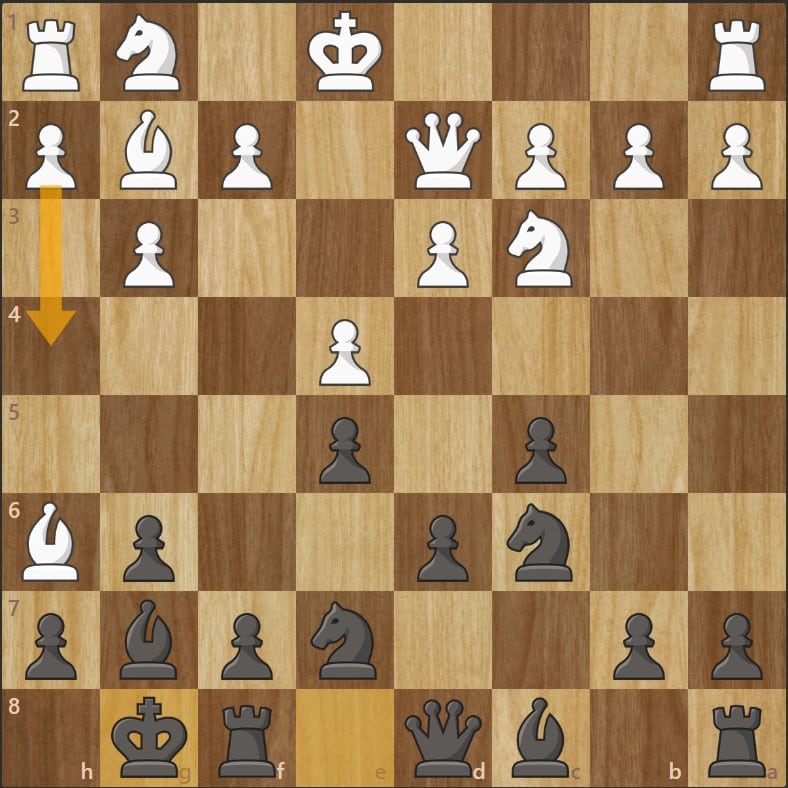
7. Qd2 Nge7
8. Bh6 O-O
Typical plan for White: push h4, then h5 to attack the kingside, trade the bishop on g7, or open the h-file.
Black, on the other hand, looks for counterplay on the queenside (…Rb8, …b5, …a5).
Alapine structure
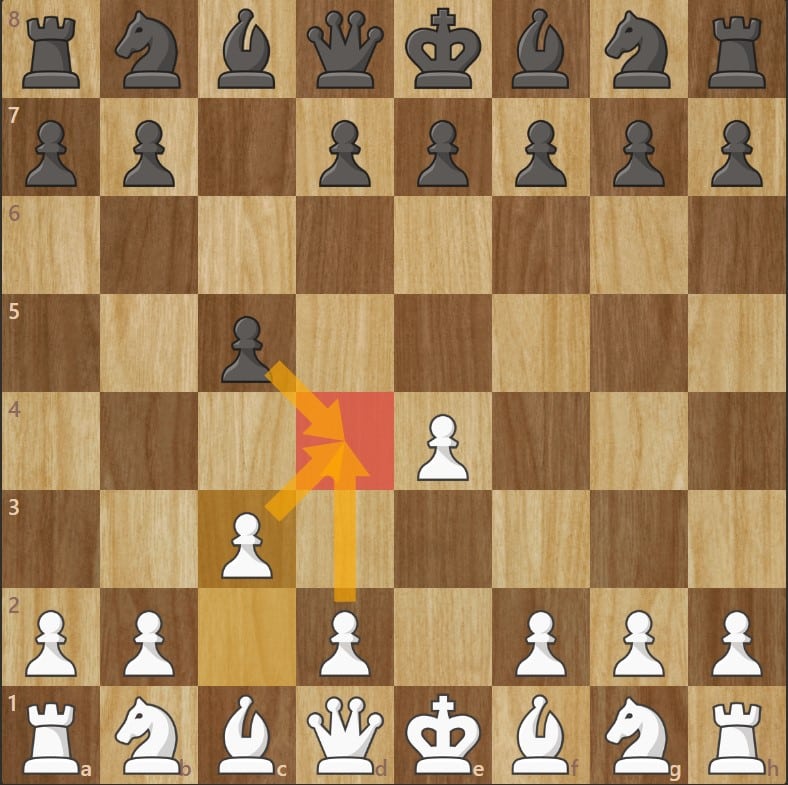
It is an anti-Sicilian system, solid and positional, aiming to reduce Black’s theoretical preparation.
White seeks to support the advance of the d-pawn.
The goal is to challenge Black’s intended central pawn majority.
Alapine structure (on e6)
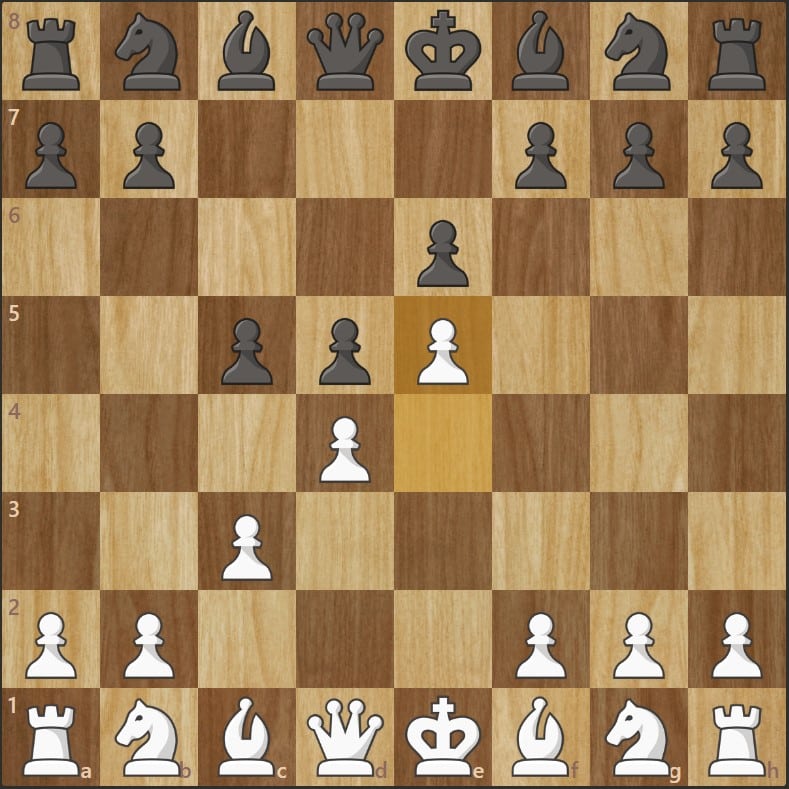
2… e6
- Black also prepares a central pawn break (d5).
3. d4 d5
- Both sides strike in the center.
4. e5
- White continues pushing forward, trying to constrain Black by taking as much central space as possible.
Alapine structure (on d6)
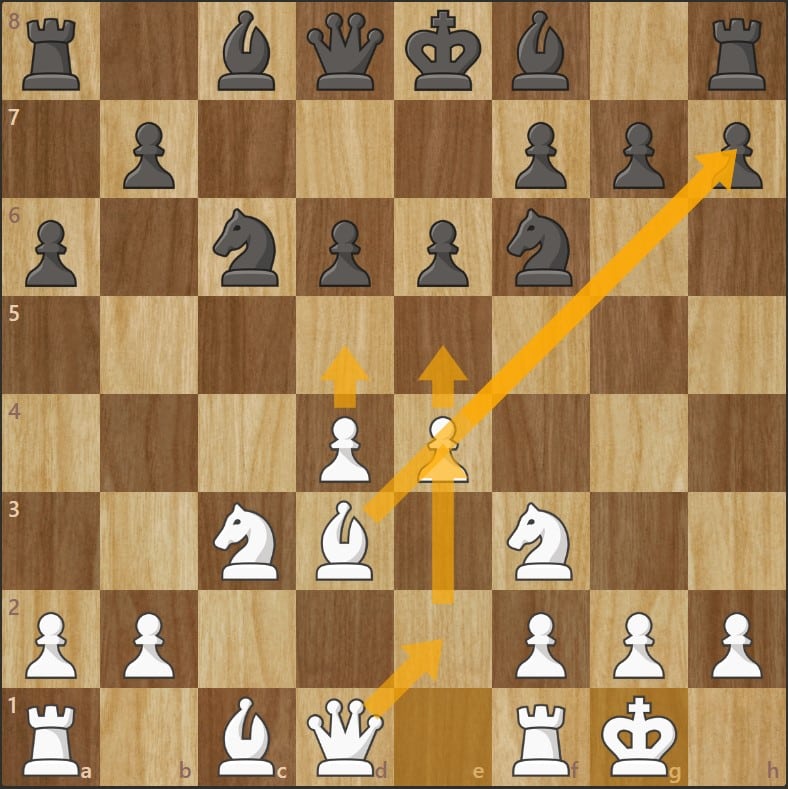
2… d6
3. d4 Nf6
- White immediately establishes their center.
- Black attacks the e4 pawn.
4. Bd3 cxd4
- White defends the e4 pawn and maintains a solid central duo (pawns on d4 and e4).
5. cxd4 Nc6
- Black exchanges on d4 to reduce central tension and develops the knight to c6, attacking d4 and preparing …e5.
6. Nf3 e6
- Natural development: White protects the center and prepares to castle.
- Black consolidates their center, opens the diagonal for the f8 bishop, and stays flexible between …Be7 or …Bb4.
7. Nc3 a6
- Black plays …a6, a typical Sicilian move, preventing Nb5 and preparing …b5.
8. O-O
White’s idea is to choose the right moment to push e5 and attack Black’s kingside castling. The queen can quickly join the attack (see diagram), creating heavy mating pressure on h7.
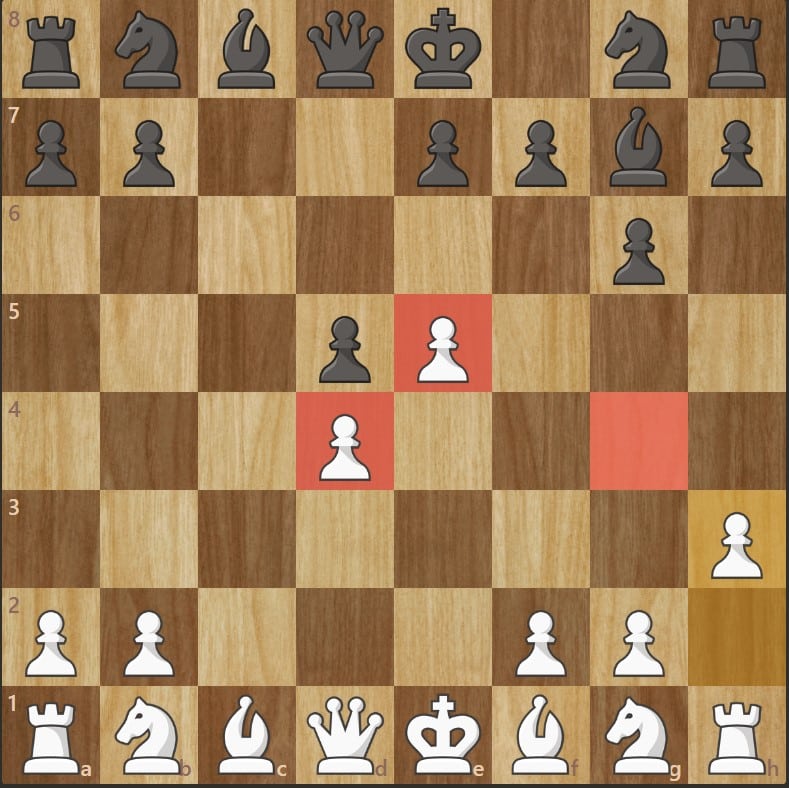
Alapine structure (on g6)
2… g6
- Black goes for an immediate fianchetto, aiming for dynamic play (Dragon-style).
3. d4 cxd4
- White establishes their central presence.
4. cxd4 d5
- Black strikes immediately with …d5 to challenge the e4/d4 duo.
5. e5 Bg7
- The e5 pawn prevents …Nf6, controls the f6 square, and gains space.
- The black bishop settles on g7, targeting d4 and the White center.
Note: capturing on d5 with exd5 would be bad for White, as it would leave them with an isolated central pawn—very weak against the fianchettoed bishop.
6. h3
A prophylactic move : prevents …Bg4, which would pin the future knight on f3.
This delays the development of the light-squared bishop and continues White’s plan to restrict Black’s activity.
Alapine structure (on e5)
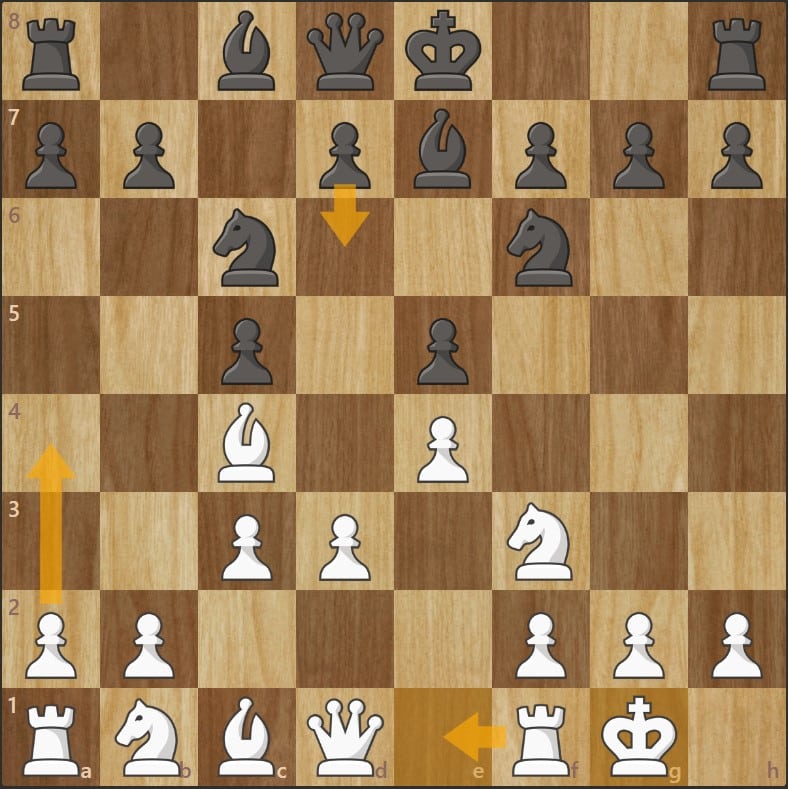
2… e5
- Black transposes into a structure similar to the Italian Opening, but with one less tempo for White.
3. Nf3 Nc6
- White’s knight attacks the e5 pawn and prepares harmonious development.
- Black’s knight defends e5 and controls d4.
4. Bc4 Nf6
- White develops the bishop to an active diagonal (c4).
- Black brings the knight to f6, attacking e4.
5. d3 Be7
- White plays solidly, defends e4, and prepares Nc3 + O-O.
- Black calmly develops the bishop and will castle soon.
6. O-O
- White secures the king and will soon connect the rooks.
We reach an inverted Italian structure: Black has copied the classical setup …e5, Nf6, Be7—but via the Sicilian move order.
Depending on your player profile, here are the variations that will suit you best :
Najdorf Sicilian
Style: ultra-theoretical, dynamic, sharp battles on both wings.
Profile: ambitious player who enjoys major strategic and tactical fights and is willing to memorize theory (Fischer, Kasparov, Carlsen).
Scheveningen Sicilian
Style: solid, flexible structure; kingside play for White vs. queenside play for Black.
Profile: balanced player who likes strategically rich positions without immediate high risk.
Sveshnikov Sicilian
Style: dynamic, with structural weaknesses compensated by piece activity.
Profile: creative and energetic player who accepts weaknesses (like the d5 hole) in exchange for active counterplay.
Dragon Sicilian
Style: spectacular race of attacks — White on the kingside, Black on the queenside.
Profile: tactical, aggressive player who enjoys sharp, knife-edge positions and precise calculation.
Closed Sicilian
Style: more positional, slow maneuvering, dark-square attacks.
Profile: patient, strategic player who prefers to avoid heavy theoretical battles.
Alapin Sicilian
Style: anti-Sicilian; White builds a solid center and avoids heavy theory.
Profile: pragmatic player who prefers to control the center and limit Black’s dynamism. A strong surprise weapon.