

Recording Your Game
Recording your chess games is a valuable habit that every player—beginner or experienced—should adopt. Beyond being a simple requirement in tournaments, notation allows you to keep an accurate record of every move played, analyze your decisions, identify mistakes and good choices, and above all, improve.
By writing down the course of a game, you develop sharper focus, better memory, and a deeper understanding of the strategic mechanisms at play.
Notation is done using a universal system called algebraic notation, which identifies each move through a combination of letters and numbers corresponding to the coordinates of the chessboard. It may seem technical at first, but in reality it is a simple, logical language that quickly becomes second nature.
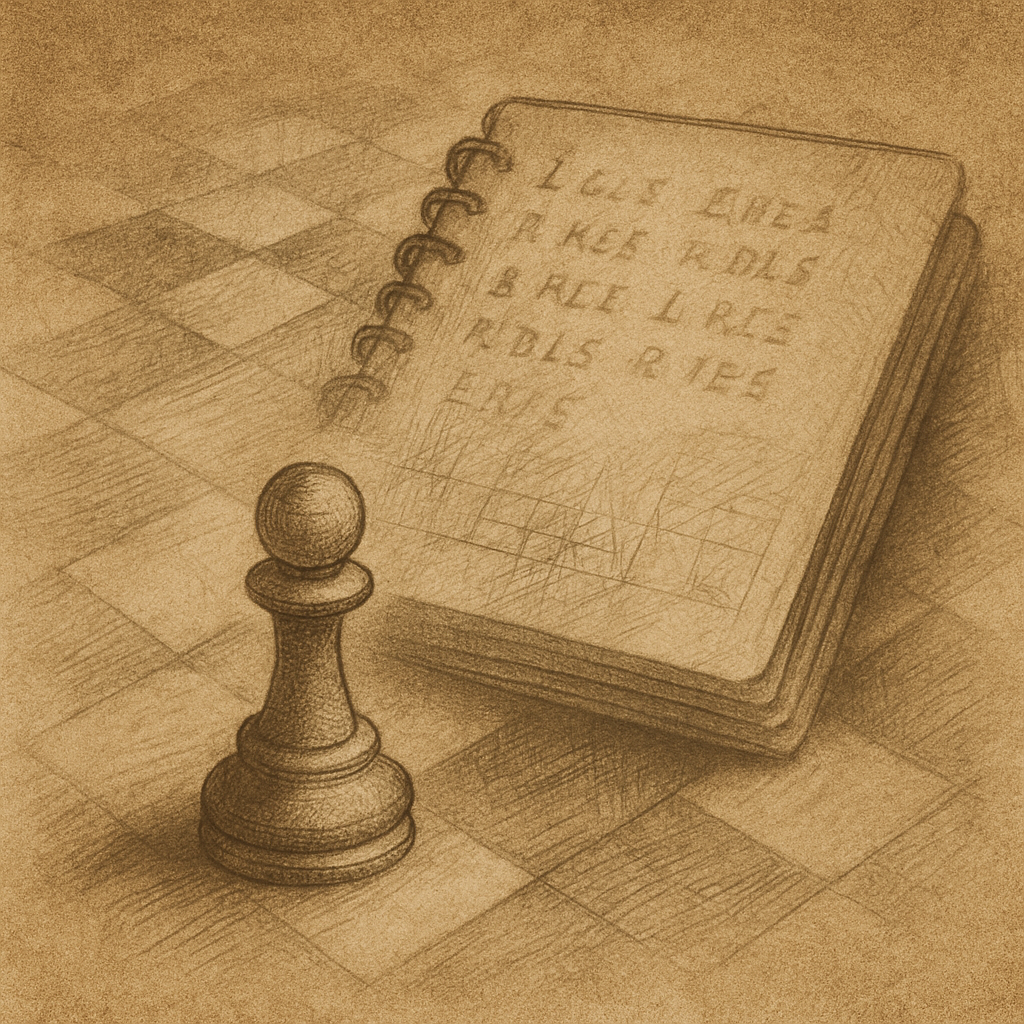
At ULTICHESS, we’ve thought of everything to encourage this practice: our set includes a specially designed game scorebook for recording your matches, along with a pencil you’ll always have at hand.
Whether you want to replay a memorable game, share a victory, or simply review an opening you’re exploring, recording your moves transforms every encounter into a lasting learning experience.
Create memories !
Types of Notation
Full Algebraic Notation
To record a move using full algebraic notation, you indicate the type of piece (using its code, or nothing if it is a pawn), the coordinates of the starting square, the movement symbol (“–”) or capture symbol (“x”), and the coordinates of the arrival square.
Moves are written using an uppercase letter indicating the piece being moved, followed by the square on which it lands.
In French, the piece codes are R for Roi (King), D for Dame (Queen), T for Tour (Rook), F for Fou (Bishop), and C for Cavalier (Knight).
In English, the piece codes are K for King, Q for Queen, R for Rook, B for Bishop, and N for Knight (since K is already used for the King).
Examples:
e2–e4: the pawn on e2 moves to e4
Nf6xe4: the knight on f6 moves to e4 while capturing a piece (the notation does not specify which piece was taken)
Move numbers are given for White only, and are not repeated for Black, whose move follows on the same line after a single space. A typical opening might look like:
e2–e4 Ng8–f6
d2–d4 Nf6xe4
etc.
In this system, several pieces of information are redundant.
Short Algebraic Notation
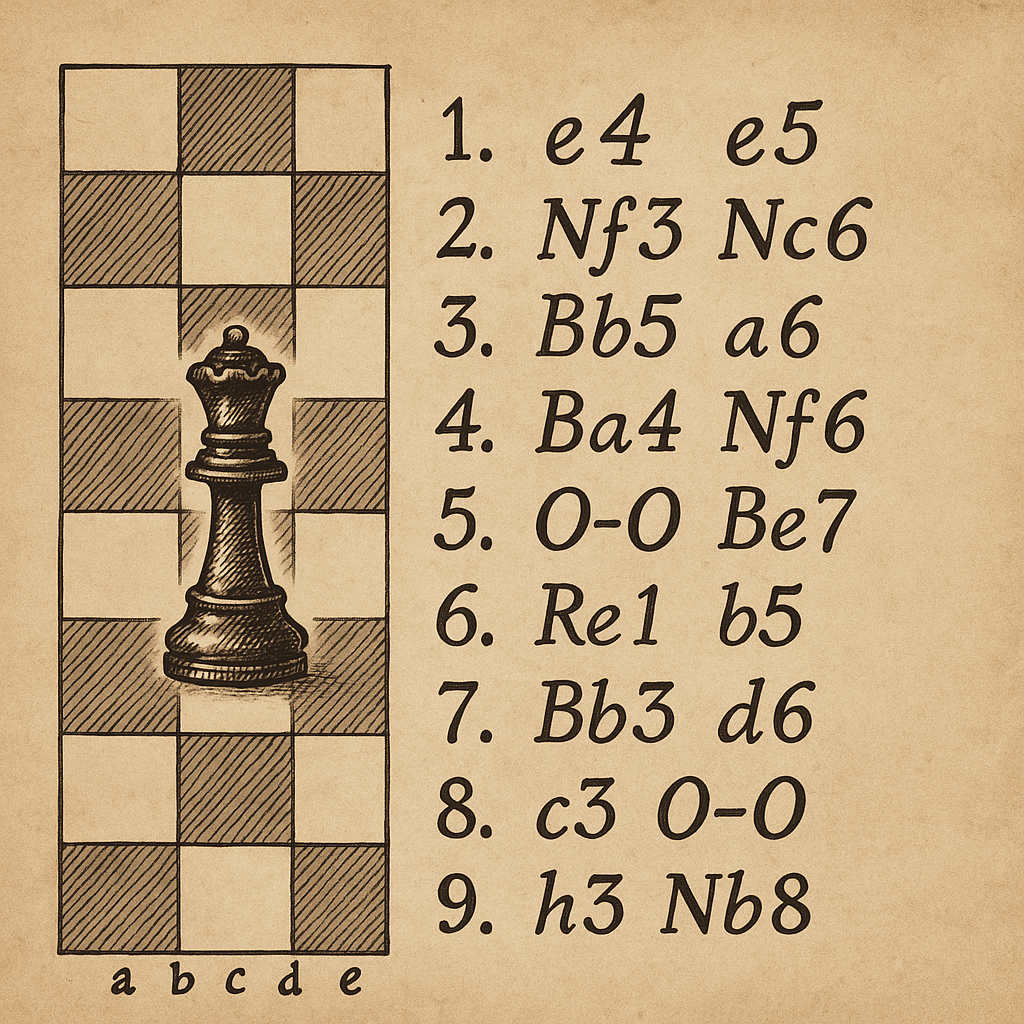
Short algebraic notation—the most widely used system today—omits the starting square and the dash indicating movement. The example above then becomes:
e4 Nf6
d4 Nxe4
etc.
This system encounters ambiguity when two identical pieces can move to the same destination square. For example, with two rooks—one on e1 and the other on a1—writing Rd1 does not indicate which rook moved.
To remove the ambiguity, an element of the starting square is added:
Red1 if the rook on e1 moved.
If ambiguity remains even after specifying the file, the rank is indicated. For example, with rooks on d1 and d3, one writes R1d2 or R3d2.
For pawn captures, the file of departure is always indicated.
Example: 2. exd5, etc.
En passant captures are written with “e.p.”
A check is indicated by a “+” at the end of the move, and checkmate by a “#”.
Stalemate, resignation, and drawn games (whatever the reason) have no special symbol and must be written out explicitly.
A draw offer made by a player should also be recorded and is noted using “(=)”.
Kingside castling is written “O-O” and queenside castling “O-O-O”.